
Let me start with something you already know: getting into Formula 1 is brutally difficult.
You’re competing against people who have been obsessed with this since they were children, who have dedicated every academic and professional choice to this single goal, and who would probably work for free just to be near the cars.
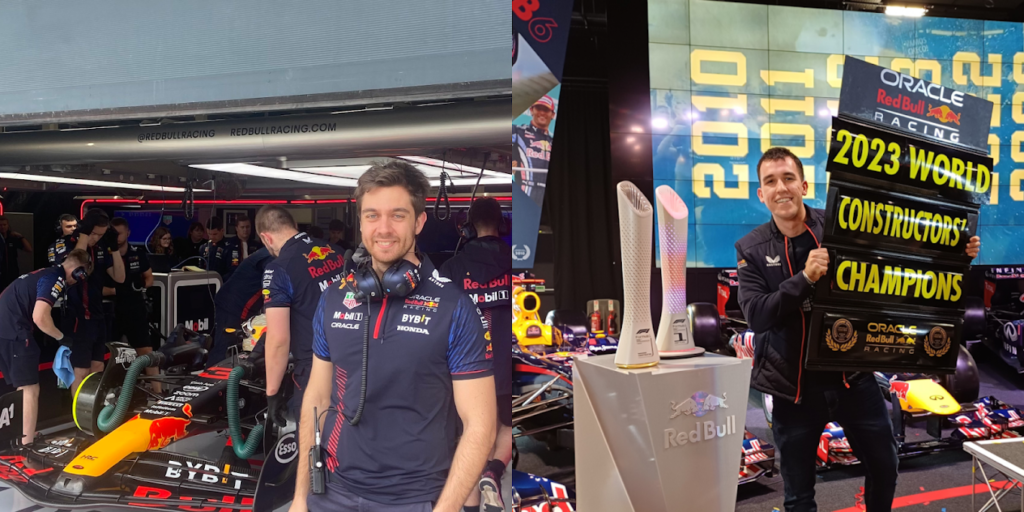
We know the feeling as we started exactly where you are now: with the same anxieties, the same doubts, the same “this is impossible” thoughts and we’re going to tell you everything. The tricks, the mistakes, the keys nobody tells you, and the interviews that break you.
Because if we could do it, so can you.
Here’s what actually matters.
Pick One Thing and Become Unstoppable at It
Formula 1 does not want generalists. Let me say that again because it’s important: F1 does not reward people who are pretty good at several things. It rewards people who are exceptional at one very specific thing.
Think about what a race team actually does. Every single person in that garage, in that factory, in that control room has a hyper-specific function. The aerodynamicist isn’t designing suspension components. The vehicle dynamics engineer isn’t worrying about composite layups. The strategy team isn’t running CFD simulations. Everyone has their lane, and they stay in it with almost religious devotion.
This means you need to choose. Seriously commit to an area. Aerodynamics, vehicle dynamics, race strategy, simulation, controls, data engineering, composites, performance engineering—pick your poison and go deep. Not kind of deep. Not “I did a module on this at university” deep. Real, uncomfortable, late-night-reading-papers deep.

The temptation to be a well-rounded engineer is strong. It feels safer, more adaptable. But in F1, “adaptable” reads as “not essential.” Teams have specialists for everything. They don’t need someone who can step in anywhere. They need someone who can solve problems that nobody else in the room can solve.
If you try to cover too much ground, you end up not standing out anywhere. And in a pile of five hundred applications for one role, not standing out is the same as not existing.
The Technical Interviews Are Not a Formality
Here’s something a lot of people underestimate: Formula 1 interviews are genuinely difficult. Not in a trick-question way, not in a “gotcha” way, but in a way that exposes whether you actually understand what you’re talking about.
Yes, soft skills matter. You need to communicate clearly, work under pressure, and collaborate with people who are all as intense as you are. But the baseline is technical competence. Real, deep, uncomfortable technical competence.
You will be asked questions that test the edges of your knowledge. You will be given problems that force you to think on your feet. You will be pushed until you either find an answer or admit you don’t know, and how you handle that moment matters almost as much as the answer itself.
Managers aren’t trying to humiliate you. They’re trying to find the best possible person for a job that demands excellence every single day. They’ve interviewed dozens of people before you, and they’ll interview dozens after.
Sometimes You Do Everything Right and Still Get Nothing
This is the part that nobody likes to talk about, and it’s also the part that breaks most people.
You can be a genuinely strong candidate. You can have relevant experience, a solid CV, be passionate about your field. You can do almost everything right. And still, nothing happens.
Why? Because of volume. Pure, brutal volume.
An F1 team might advertise one engineering role and receive up to a thousand applications. A thousand. From people all over the world, many of whom are also strong candidates. The HR team has maybe a week to whittle that down to a shortlist of ten or fifteen people to actually speak to.
In that environment, great profiles slip through the cracks. Not because they’re not good enough, but because there are too many good profiles and not enough time. It’s not personal. It’s not a reflection of your value. It’s just math.
What do you do with that information? You don’t get angry. You don’t decide the system is rigged. You accept it as part of the process and keep going. Apply again. Apply to different teams. Apply to different roles. Stay consistent and don’t let the silence make you bitter, because bitterness shows up in your applications and in your interviews, and it’s one of the fastest ways to get yourself overlooked.
If You’re Not Getting Interviews, Look at Your CV
There’s a difference between being qualified and communicating that you’re qualified. If you know your experience is relevant but you’re not getting calls, your CV isn’t doing its job.
Most candidates make the same mistakes. They use generic descriptions that could apply to any engineering role. They bury their most impressive achievements under paragraphs of fluff. They miss keywords that hiring managers and automated screening systems are looking for. They structure things poorly so that the important information isn’t immediately visible.

Here’s the thing: when someone in HR is scanning a CV, they’re looking for specific signals. They want to see certain terms, certain projects, certain technical language. If those signals aren’t there, or if they’re hidden, the CV gets passed over regardless of how good the experience actually is.
Small changes make a huge difference. Clearer project descriptions. Stronger technical language. A layout that puts relevance front and centre. Sometimes it’s not about adding more—it’s about removing the noise and letting the signal through.
And if you’re serious about this, get someone else to look at it. A fresh pair of eyes will spot things you’ve been blind to for months.
Specialisation and Luck Are Both Real Factors
Here’s an uncomfortable truth: luck plays a role. Not the deciding role, but a role nonetheless.
You can be a brilliant aerodynamicist, but if there’s no aerodynamicist role open at the time you’re applying, you’re not getting in. You can have perfect timing, but if your specific expertise isn’t what the team needs right now, you’re not getting in. You can be exactly what they’re looking for, but if someone with slightly more experience applied two days earlier, you’re not getting in.
That doesn’t mean it’s random. It means you need to be strategic. You need to be realistic about where your background actually fits. Applying as a generic mechanical engineer to an aerodynamics role won’t work unless your projects, research, and experience clearly demonstrate aerodynamic expertise. And even then, you’re competing against people who have been doing aerodynamics full-time for years.
Ask yourself honestly: does my background match the role? Can I prove that on paper? Am I targeting the right positions? Being honest with yourself saves a lot of wasted effort.
Build Yourself Even If It’s Not F1 Yet
Sometimes the role you want is just out of reach. Not because you’re not good enough, but because you need something else first.
Maybe you need one more year of experience in a specific area. Maybe you need to take a slightly different role that gets you closer to the kind of problems F1 teams deal with. Maybe you need to work in a different industry that exposes you to similar challenges—motorsport is not the only place where complex systems, high performance, and extreme reliability matter.

Every job is a stepping stone. Every project builds skills. Every problem you solve makes you more valuable. The goal is not to get into F1 as quickly as possible. The goal is to become the kind of person who is genuinely valuable to an F1 team, and that takes time.
A flexible approach often gets you there faster than a rigid one. If you fixate on one team, one role, one specific path, you close yourself off to opportunities that might actually be better for your long-term development. Stay open. Stay curious. Keep moving forward.
Enjoy the Process
This sounds like something people say to make you feel better, but it actually matters.
The dream of getting the job. The excitement of an interview invite. The rush when you get a reply. The nervous energy before a technical assessment. It’s all part of the journey, and if you can’t find some enjoyment in that, the wait will crush you.
The people who make it are usually the ones who stay curious, who keep improving, who find satisfaction in the work itself rather than just the end goal. They’re the ones who are genuinely interested in what they do, who read papers for fun, who tinker with projects outside of work, who never stop asking why.
If you’re only doing this for the destination, you’ll burn out long before you get there. But if you can find meaning in the process, if you can enjoy getting better, if you can stay excited about the work itself, you’ll not only become a stronger candidate—you’ll also enjoy the ride a lot more.
And when you finally get there? It’s worth it. Every late night, every rejection, every “we decided to go with another candidate.” Because you’re not just getting a job. You’re getting into a world that very few people ever experience, and that’s something worth fighting for.